

Last Updated: November 1, 2026
Quick Summary
High quality fabric is even in its fibres, weave or knit, and finish, and it springs back when squeezed. You can check these traits by hand, with a simple light test, and by reading the fibre content and care information on the label.
- Hold the fabric against light and check for even glow without thin spots or streaks.
- Scrunch a section tightly for about 10 seconds; quality fabric springs back with few creases.
- Rub a white tissue against coloured areas; colour on a damp tissue is a warning sign.
- Look for fibre percentages, care instructions and pre-shrunk or colourfastness claims on labels.
Table of Contents
- What Makes Fabric High Quality in Practice
- How to Check Fabric Quality by Touch and Handle
- Signs of High-Quality Cotton Fabric
- Fabric Weight and GSM Explained
- How to Read Clothing Fabric Labels
- Light, Weave and Colour Tests You Can Do at Home
- Checking Fabric Durability and Long-Term Care
- Booking a Fitting or Requesting Fabric Details Before You Buy
- Frequently Asked Questions
Most people judge fabric quality only after a shirt pills or a skirt loses its shape. Knowing what to check for high quality fabric in the shop or on a product page saves money and disappointment.
Fabric quality is about how a cloth looks, feels, holds its shape and survives wear. Price alone tells you little. These seven checks work for most garments, from a silk blouse to a wool-blend knit or cotton trousers.
What Makes Fabric High Quality in Practice
High-quality fabric usually shows several traits together: even fibres, a tight, consistent weave or knit, a smooth surface that is not flat or shiny, even colour, and recovery when pinched.
A common mistake is judging only the label. "Pure cotton" can describe a thin, loose fabric or a dense, long-staple one. The label tells you the fibres, not how well they were spun, woven or finished.
Look at the fabric as a whole:
- Consistency: No thin patches, slubs or uneven colour
- Recovery: It springs back after being squeezed
- Finish: Smooth, with no loose threads or glue-like coating
- Weight: Substantial for its type, not papery or flimsy
How to Check Fabric Quality by Touch and Handle
Touch tells you more than most people expect. Rub the fabric gently between your fingers. High quality fabric feels even and firm, with a soft surface that is not rough, sticky or waxy.
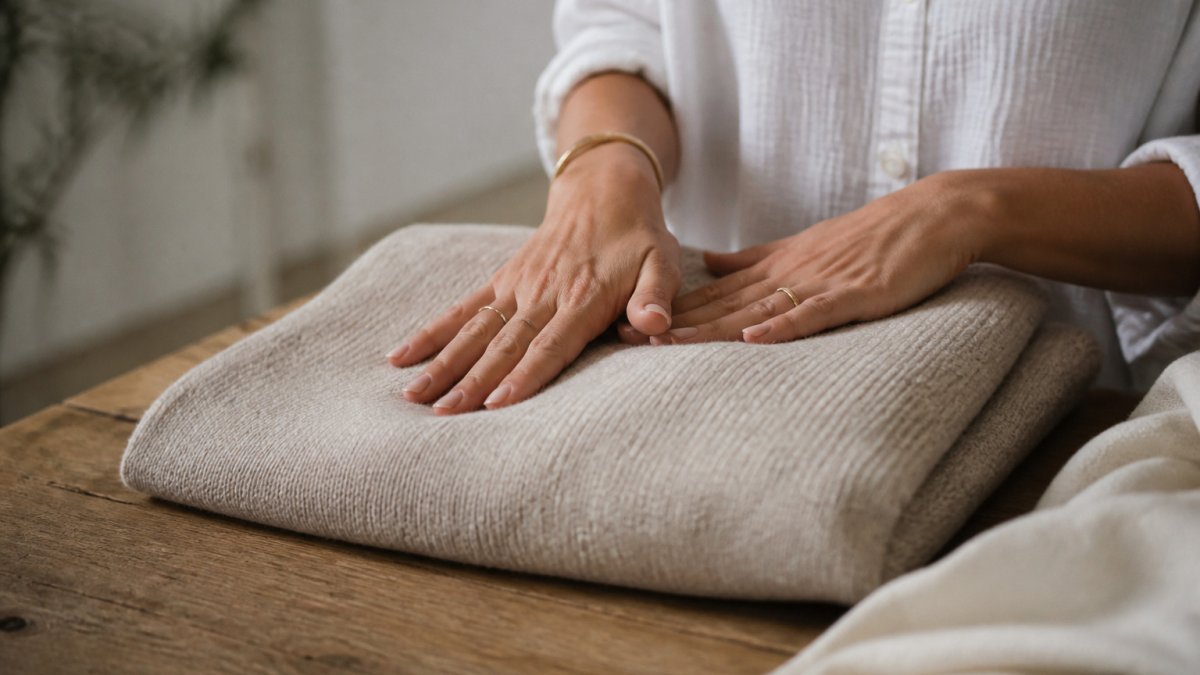
Scrunch a section tightly in your fist for about 10 seconds, then release. Quality fabric springs back with few creases; fabric that stays wrinkled will likely show the same wear after a few months.
Run your hand across the surface against the grain. Watch for snags, bobbles or rough patches. These are early signs of pilling or poor finishing.
Watch out: A soft feel can come from a chemical finish that wears off after washing. Ask whether the softness will last, or test the fabric after a gentle wash.
Signs of High-Quality Cotton Fabric
Cotton is one of the most common fabrics in everyday clothing, and quality varies a lot. Good cotton has a clean, even surface and a slight natural sheen, and feels cool and breathable, not thin or scratchy.
Check these points on cotton:
- The weave looks even, with no gaps or thick threads
- Colour is uniform, not patchy or streaked
- The fabric feels substantial when you hold it up
- Seams and edges show no fraying or loose threads
Fabric Weight and GSM Explained
GSM stands for grams per square metre. It measures how heavy a fabric is for its size. A higher GSM usually means a denser, more structured fabric, while a lower GSM means a lighter, more fluid one.
GSM is useful for comparing fabrics of the same type: a 180 GSM cotton jersey feels very different from a 300 GSM one. You can see a denim jacket's fabric and weight listed in detail. Heavier is not always better; the right weight depends on the garment and season.
- Light (under 150 GSM): Drapes well, suits summer tops and linings
- Medium (150 to 250 GSM): Versatile, suits most everyday pieces
- Heavy (over 250 GSM): Holds structure, suits tailored or winter pieces
GSM is often listed for knitwear and jersey. For wovens, weight is less commonly stated, so check the handle and drape instead.
How to Read Clothing Fabric Labels
Labels list fibre content by percentage, usually highest to lowest.
Look for these details on labels:
- Fibre content: The main fibres and their percentages
- Care instructions: Washing and drying symbols or written guidance
- Country of origin: Useful for tracking where the garment was made
- Lining or backing: Often a separate fabric with its own content
Be careful with vague terms such as "premium blend" or "luxury fabric" with no fibre details.
Light, Weave and Colour Tests You Can Do at Home
Most guides mention a light or rub test in a single sentence, without saying what a pass or fail looks like or when the test misleads.
1. The light test (density and thin spots). Hold the fabric flat against a window in daylight, or a phone torch about 10 cm behind it in a dim room. Judge the evenness of the glow, not its brightness. Good fabric transmits light evenly; fail signs are bright pinpricks (thin spots), streaks (uneven density) and a tissue-like glow.
2. The weave and knit consistency test. Lay the fabric flat and look along the surface at a low angle with raking light. For wovens, check that warp and weft sit at right angles with uniform gaps; pull gently on the bias and release, and a good weave returns without distorting.
3. The colour rub test (dye fixation). Rub a white tissue firmly across a coloured area for about 10 seconds, then repeat with a slightly damp tissue. A little surface dye on the dry tissue is common on dark indigo and can signal a natural or garment-dyed finish rather than a defect.
4. The snag and abrasion spot check. Run a fingernail or coin edge lightly across the surface against the grain, then rub the same spot with your thumb for about 20 seconds. Fuzzing or a halo of loose fibres is an early pilling signal.
Fibre-specific adjustments. Cotton and linen wovens should pass the light test evenly with a clean grain. Wool and blends often look slightly fuzzy under raking light, which is normal, but should not show thin patches; check the rub test carefully, as loose wool fibres pill readily. Silk passes the light test with a warm, even glow but fails the rub test easily if the dye is poor, and water spotting makes the damp rub unreliable, so use the dry rub only. Synthetic knits often pass the stretch test but fail the abrasion spot check, the better predictor of pilling.
What these tests cannot tell you. None measure abrasion resistance, dimensional stability after washing or colourfastness to light; those need laboratory testing, and a retailer quoting a test result gives stronger evidence than any in-store check. Treat the home protocol as a filter for obvious poor-quality pieces, not a substitute for a specification.
The article sets out a five-minute sequence of home checks, each with a clear pass or fail sign.
| Test | What to do | Fail sign |
|---|---|---|
| Light test | Hold fabric against daylight or a torch about 10 cm behind it | Bright pinpricks, streaks or a tissue-like glow |
| Weave and knit consistency | Look at raking light; stretch knits about 10 cm sideways and release | Gaps that stay open, skewed grain or loops that do not close |
| Colour rub test | Rub a white tissue dry, then damp, for about 10 seconds | Colour on the damp tissue |
| Snag and abrasion spot check | Rub the surface against the grain, then the same spot for about 20 seconds | Fuzzing or a halo of loose fibres |
Checking Fabric Durability and Long-Term Care
Durability is the hardest quality signal to judge in a shop, because failures appear after ten, twenty or fifty washes. For ideas on building a wardrobe of long-lasting pieces, see our guide. Know what each failure looks like, what causes it, and which labels give you evidence before you buy.
Pilling. Pills are small balls of tangled fibre that form when short or loosely twisted fibres work free and knot under friction. Fabrics with long-staple fibres and tighter twist pill less, and wool-synthetic blends often pill more than either fibre alone because the stronger synthetic holds the pill on the surface.
Shrinkage. Most natural fibres relax and shrink on first washing unless pre-shrunk or finished to control it. Cotton knits are the classic case; wool can shrink dramatically and felt if washed warm or agitated. Look for pre-shrunk, sanforised or compacted on the label or product page.
Colourfastness. This is the fabric's resistance to fading and bleeding. It is measured in the laboratory against light, washing, rubbing and perspiration, and results are usually reported on a grey scale from 1 to 5, where 5 is best.
Abrasion and strength. Abrasion resistance is measured in the lab by rubbing fabric against an abrasive surface and noting the cycle count at failure; higher is better for the same fabric type. You will rarely see this on a clothing label, but it is common in upholstery and workwear specs.
Seams and construction. Fabric can be sound and still fail at the seams. Check that seam allowances are wide enough not to fray, stitching is dense and even, and stress points such as armholes and crotch seams have a second row of stitching or a reinforced finish. Narrow, single-stitched seams wear out first.
Care that preserves quality. Wash less often and cooler than you think you need to. Air knitwear flat rather than hanging, because wet wool stretches under its own weight. Turn garments inside out to reduce surface abrasion.
Australian Competition and Consumer Commission guidance on textile and clothing labelling
Booking a Fitting or Requesting Fabric Details Before You Buy
If you are unsure about a piece, ask for more detail before you commit. Many shoppers do not realise they can request fibre content, weight or care information for a specific garment.
If you are shopping online, read the product description closely and look for fibre percentages and care information.
Fitting questions matter too. Ask about sizing and how the fabric fits in real life.
Australian Competition and Consumer Commission guidance on textile and clothing labelling
Australian Government Department of Health and Aged Care guidance on textile care and fibre safety
Woolmark Company research on fabric performance and wool blends
Frequently Asked Questions
How do you recognise good-quality fabric?
Good-quality fabric feels even and substantial when you handle it, with a smooth surface and no loose or missing threads. Check that the weave or knit is consistent across the piece, hold it up to a light source to see whether it is evenly dense, and look for a fibre content that suits the garment's purpose. Fabric that feels thin, papery or uneven at the edges is usually a warning sign, particularly at a higher price point. Compare two samples side by side where possible, since the difference is easiest to notice in direct comparison.
Does a higher GSM mean better fabric?
Not automatically. GSM (grams per square metre) measures weight, and heavier fabric is often more durable and less sheer, but weight alone does not confirm quality. A dense, poorly constructed fabric can be heavy and still pill or stretch out of shape. Use GSM alongside fibre content, weave consistency and how the fabric drapes. For a structured jacket you may want a heavier weight, while a fluid blouse usually suits a lighter one.
How can you check fabric quality when shopping online?
Start with the product page: look for a clear fibre composition, a stated weight or GSM, and care instructions. Detailed close-up photos showing the weave and how the fabric drapes are a good sign. Read reviews that mention fit, feel and how the garment held up after washing. Check the returns policy before you buy, so you can test the fabric in person and send it back if it does not meet your expectations.
What should you check when assessing fabric quality?
Check the feel and handle, the weight, the consistency of the weave or knit, the fibre content, and the colour evenness. Hold the fabric against a light source to spot thin patches or gaps. Run your hand across the surface to test for roughness or stiffness, and inspect the seams and edges for loose threads. Finally, consider how the fabric will behave over time, including pilling and shrinkage after washing, since these show whether a piece will last.
